Monday, October 17, 2011

A suspense bridge: Leaving my man-card in the U.P.


Like every good American man, I ain’t afraid of nothing.
I eat steaks, drink whisky and scoff at danger.
If I get a nail in my hand, I take a slug from the flask and pull the nail out with my teeth.
And silently bear the pain.
No crying. No bellyaching.
I’ve always tried to embody Hemingway’s dictum: “grace under pressure.”
Except when it comes to bridges. And, well, doing anything that would actually involve putting a nail in my hand. Give me a hammer and I’ll try pounding with the wrong end.
We all have our fears and phobias. I happened to suffer from a mild case of gephyrophobia, a fear of driving over bridges.
Don’t ask me how to pronounce it.
I failed to mention this to my wife this past weekend when we made a trip to the Upper Peninsula. Just as we reached the electric road signs that tell you to tune into the radio station for bridge information, she noticed a slight change in my driving demeanor.
“You OK?” she asked.
I didn’t tell her about my increased heartbeat rate. My dizziness. My cold and clammy hands.
“I’m fine,” I said. “Great.”
“Greetings from the Mackinac Bridge Authority,” a robot voice on the radio said. “We are experiencing very heavy winds today. Due to extremely frightening winds, we are escorting special vehicles across the bridge. Special vehicles include trucks hauling trailers, semis and anything driven by John Counts. If these types of special vehicles are not escorted across, the will surely plunge to a cold, horrifying death off the side of the bridge.”
That’s not what the radio said, of course, but that’s how I heard it. Then the main towers came into view, a bewilderingly 552 feet above water. The road itself is 200 feet high at midspan.
I shivered in my seat.
That’s a long way to fall.
I saw it all clearly my head: my car slowly moving across the bridge when a huge gust of wind comes whipping up from the Straits, lifting up the car and dropping it into the drink.
“Are you sure you’re OK?” my wife asked. “You look like you’re going to snap the steering wheel off.”
“I don’t like driving over bridges.”
There it is was. My confession. Now, my wife would know me for the weakling I am. But it’s been this way since I was a kid. The sight of the Mighty Mac has always made me dizzy in the same way that staring up the side of a skyscraper does in a big city.

It reminds me of how small we are, I suppose. That we are so inconsequential in the grand scheme of things. Which is probably why we build giant buildings and bridges to begin with -- to assert our domination.
Well, in regards to the Mighty Mac, I am the one that’s dominated -- with fear. I like to think it makes me humble.
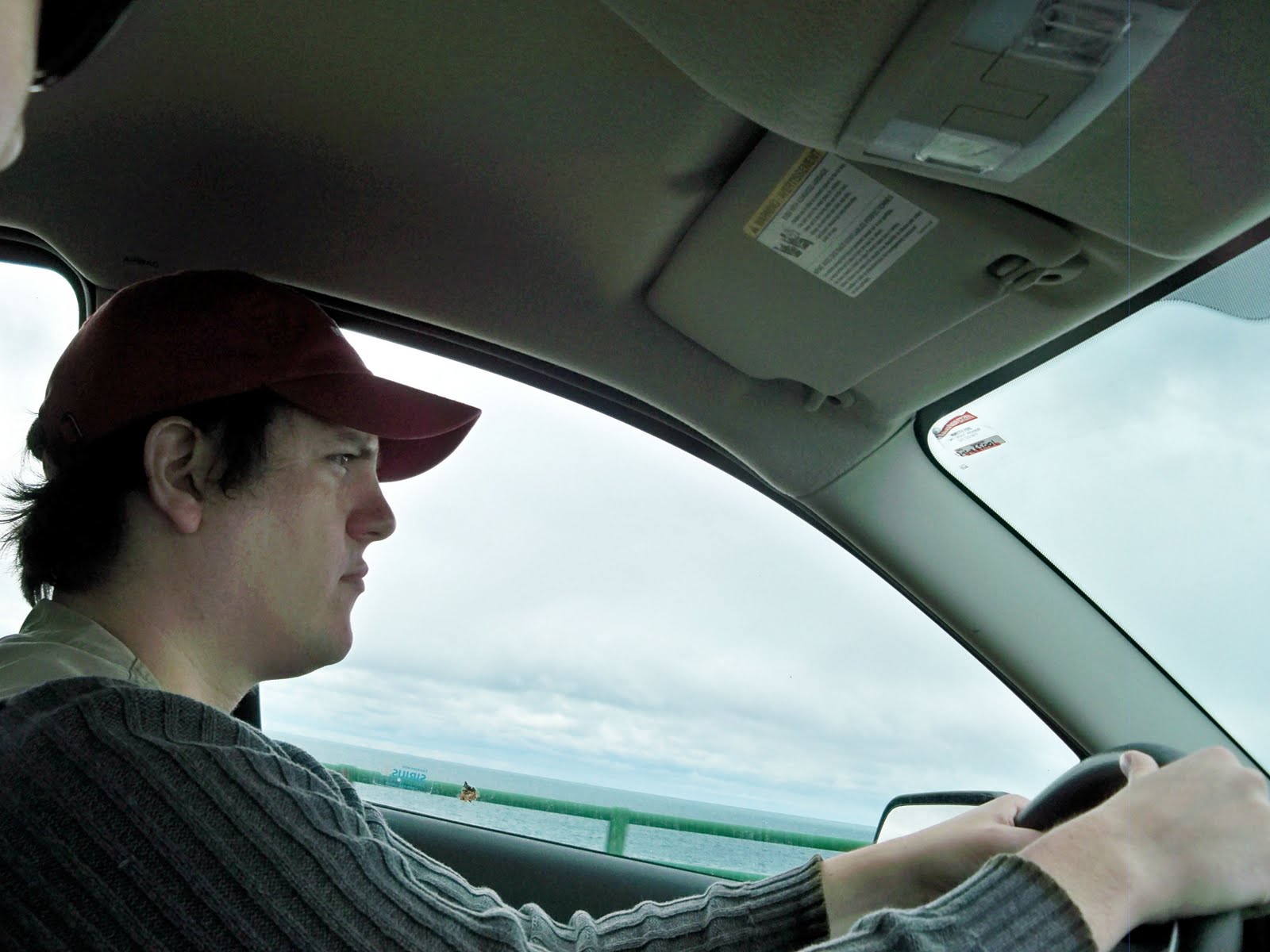
I was ramrod straight, hand at two and ten o’clock on the steering wheel -- the way they teach you in driver’s training -- as I ascended the bridge.
My wife snapped a picture.
“Turn it off!” I screamed.
She giggled at me and put the camera away.
I stayed locked into the same driving position the entire five miles across the bridge. They call them suspension bridges, but I think of it as a bridge of suspense. Now, when you’re driving across the bridge, you can either go grate or rail. Both are not preferable. Driving in the outer lane, and you’re that much closer to the edge. Drive on the grate, and one of them is liable to come loose and drop you right through the road. Down and down 200 feet.
I always choose the grate because that seems slightly less likely to happen.
As I reached the toll on the U.P. side, I exhaled a giant sigh of relief. I smiled. I had made it over one more time without plunging to my death.
“Maybe we can take the ferry on the way back,” I said. “That might be fun.”
“They don’t have a ferry anymore. How about I just drive?” my wife said.
I didn’t argue with her.

Wednesday, September 28, 2011

Working stiffs: The Great American Job is dead and gone

Someone who is unemployed is watching television in their parents’ basement right now.
There are thousands of them. And they’re not young anymore. They’re in their 20s, 30s, 40s and 50s.
They don’t have a job even though they’re dying to work.
In Bay City when I was a kid, it was common for the older guys in high school to blow off studying because they would just go work at “The Chevy” when they turned 18.
Now, kids in that town -- and towns across the country -- are probably lucky to get a fast-food job upon graduating high school, college, even graduate school. And, since there’s a recession on, they’re probably told they’re lucky to have it.
These McJobs will keep an entire generation in their parents’ basements if something doesn’t change.
The idea that you’ll be able to prosper in this country as long as you work hard just isn’t true anymore. The Great American Job is dead and gone.
The Great American Job once meant enough income to comfortably pay for a house (that you own), a car or two, food and sundries and maybe enough left over to save a little for retirement or college for the kids. If you were lucky, you’d even have enough for a vacation once a year.
Is that too much to ask?
In the manufacturing sector, jobs have been replaced by robots and shipped overseas. Try and apply for what manufacturing jobs that are left armed with a high school degree and you’ll discover the competition is fierce, and not with people just trying to get started in the workforce, but folks who have been there for decades.
In the professional world, bachelor degrees used to mean something a generation ago, but now they are the equivalent of a high school degree. A lot of people have them, but it doesn’t guarantee any opportunities. For highly competitive jobs, you need a half dozen internships and to graduate near the top of your class. That’s great for those do-gooders, but what happens to the vast people in the middle who are average? Should they be relegated to sitting in their parents’ basement watching television?
So what is the best way to create jobs for these people?
That’s all I keep hearing from Washington. And I honestly think no one has the answer, including myself. The government shouldn’t be the sole creator of jobs, but neither should private industry. We don’t want the Government to get its fingers too intertwined in the means of productions. We all saw what happens when ideas like that are implemented. A colorless, fearful world of repression.
But what these Tea Party, limited government yahoos don’t want to acknowledge is that Europeans already had an arguably government-less economy without any regulations back in the days of oligarchies, when the nobility ruled over a peasantry.
Do we want America to resemble this? A mass class of peasants who serve up Frostys or help swipe debit cards at the gas station?
A very small middle class that is successful only based on their loyalty to the nobility?
And then the few at the top controlling all the wealth of our nation?
Without regulations, this New American Nobility would pay you less and expect more work because that’s what makes the highest profit, and making the highest profit is the basic guiding principle of business.
Whatever they figure out in Washington, I hope it’s a mixture of both. And it better be quick. The pessimism has grown strong. We need to dig ourselves out now.
Or pretty soon we won’t have any basement to go home to.

Another Ice Age or Dark Age?

As a child, I used to go to the Outer Banks of North Carolina this time of year on family vacations.
We had planned on going again this year -- last week, in fact. I’m sure glad we didn’t.
Anyone with a television or an Internet connection knows about how Hurricane Irene swept up the East Coast and hit the OBX pretty hard.
Whenever wild weather happens, we can’t help but think the worst: global warming. Well, that’s what you call it if you’re a hippie. If you’re on the other side, it’s called climate change.
See, the far left thinks all business should cease until we can restore the planet to what it was like before the dodo bird became extinct.
The other side thinks global warming is B.S., that either the scientific data is wrong, or that the scientists are in a vast conspiracy to impose such an insidious belief on the masses. If the weather is changing, the argument goes, it could just be natural.
So, is it the beginning of a new Ice Age, as a certain faction of Republicans would have you believe, or is the far right trying to usher us back into the Dark Ages?
“I think we’re seeing almost weekly, or even daily, scientists that are coming forward and questioning the original idea that manmade global warming is what is causing the climate to change,” said Republican presidential candidate Rick Perry in an Associated Press story recently.
Maybe Perry is listening to the “scientists” who designed the Creation Museum in Kentucky that has dinosaurs running alongside Jesus and other characters from the Bible. The far right’s definitely not known for its artistic prowess, but they also seem pretty deficient on that whole science subject too.
But you are the people they are trying to sell on these ideas. Do you believe them?
If you don’t believe in the science of global warming, ask yourself why?
Take out all the specifics, the details, and it comes down to this question: Do you think human beings have an impact on Earth?
If you live in a house and don’t open the windows for years, what would it smell like in there?
If you never had any maintenance done on your car, how would it run in a few years?
Do you really think billions of people crawling all over the planet doesn’t have some sort of effect?
It’s not political. There’s no conspiracy. It’s common sense.
I’ll leave the rest to the scientists the far right scoffs at, the same discipline that brought you such crowd-pleasing favorites as penicillin, airplanes and television.
In this regard, the far right is trying to drag us back into the Dark Ages where people were burned at the stakes for having any sort of opinion that ran counter to the Church. Now, instead of the Church, there’s Big Oil and every other interest that is tied to burning fossil fuels.
Is it too progressive or liberal to believe in science?
I hope I can still be considered a moderate if I think that Newton’s theories on gravity are OK. I hope I’m not considered a hippie if I believe the Earth is, in fact, round.
When it comes down to it, if you’re having a heart attack or stroke, do you want the science of rational folks who believe in evolution and global warming, or do you want a faith-based doctor -- I think they call them preachers -- at your side?

“All changed, changed utterly”: A view from Chicago on 9/11

Ten years ago I was 23 and living like most do at that age: desperate, impoverished, wildly irresponsible.
I had graduated from Wayne State University months earlier, in July, with a hopeless English degree. I could theorize with the best of them about the novels of French writer Albert Camus or quote from poems by William Butler Yeats, but I couldn’t land a decent job.
Throughout college, I had alternately lived with my parents in the burbs or on-campus in Detroit. After graduation, I followed my brother and then-girlfriend to Chicago. The girlfriend was still in school and lived in a sprawling, three-bedroom Northside apartment. I moved in, the only dude among three ladies.
I was ready to light the world on fire.
But so were the terrorists.
I truly hustled to find any kind of work I could. I scoured the Want Ads in the Chicago Reader, the town’s alternative weekly. I made dozens of calls.
Only one called back: The Chicago Opera Theater.
I had worked as a telemarketer during my teenage years, experience that landed me an interview. I hated the thought of selling, but it wasn’t like I’d be hawking something sleazy like male enhancement pills over the phone, I’d be helping to support the arts.
I got the job. My first day would be September 12.
On September 10, knowing that I was starting a new job and I wouldn’t have the luxury of spending my days watching television through a haze of cigarette smoke all day, I celebrated my newfound employment deep into the night.
Probably a little too late.
I was still asleep when the first plane hit.
It was a collision that changed my generation. And there I was. Asleep. Hungover.
I didn’t have a cell phone yet, so the call came in on the landline. I’m surprised it wasn’t being tied up by the gossiping gals.
It was my brother.
“Turn on the TV now.”
“Dude, I’m sleeping,” I managed to utter.
“I’m serious.”
Out in the apartment’s “family room,” which had the habit of attracting stray party people at anytime of the week, the TV was already on. Four or five people sat around on old, second or third-hand sofas and love seats watching the news.
I don’t remember who was there anymore. But I do remember seeing the second plane hit.
For a generation of kids who thought that “everything had been done before,” this was something that dropped all of our aimless jaws.
“What the ... !” we collectively said.
Chicago has big buildings, especially the Sears Tower. We dared not leave the apartment for the rest of the day. Patriotism, something not typical in the grungy Northside apartment, became fervent.
As Yeats said, “All changed, changed utterly.”
We were glued to the television, watching the world utterly change. All those needless deaths were sickening. The reverberations are still being felt. I would argue that the economy still hasn’t fully recovered. Nothing has ever been the same since that day.
All changed, changed utterly.
The next day, when I had to start the new gig as a telemarketer, I figured they would send us home, but they didn’t. For a few hours, I made calls asking people if they wanted to buy tickets to see Mozart’s “Cosi fan tutte.”
Most people hung up.
One guy said, “Do you know what just happened yesterday?”
I apologetically said I did and told him I was just doing my job.
He, too, hung up. The supervisor finally let us go home.
And we all did. But they weren’t the same homes anymore, all across the country.
All was changed, changed utterly.

Monday, September 5, 2011

Our boon companion: One year with Rudy the Wonder Dog


A year ago this week, we brought Rudy home from the Homeward Bound Animal Shelter.
There hasn’t been a dull moment since. It’s been a fantastic year with Rudy, or Roo, or Rudence, or Rude Dog, or any of the nicknames that come out of the mouths of my wife, Meredith, and I.
A lot has changed in that year, though. Believe me.
As a pup, I could hold him with one arm. Now, he’s as long as the couch when he stretches out.
Back then, he could barely climb the stairs. Now, he can hop up on a four-foot ledge in a single bound.
Lake Michigan terrified him last summer. Now, he’ll race out into the water and grab whatever you throw for him. You’d think he was part lab.
And according to his papers, he is, though you wouldn’t know it to look at him.
To us, he’s just a mighty mutt. Rudy the Wonder Dog. In the fall, he’s that elusive breed: the Manistee County Grouse Hound. All we know about him is that his mom was a lab mix and that pappa was a rolling stone.
But that hasn’t stopped people from guessing.
Walking Rudy around town is like escorting a celebrity. In fact, one day a gentlemen told me that Rudy “looked like a movie star.”
I thanked him and yanked Rudy away, hoping it didn’t go to his head. Rudy, as always, pranced off. He’s the fanciest prancer of a dog I’ve ever seen, which is why strangers stop us. He’s also chock-full of playful energy and has seemingly elastic ears that point and droop depending on his mood.
But the one thing people who stop us on the streets want to know is his breed.
I’m sorry, folks, but I don’t know if he’s part whippet, Jack Russell, dalmatian, pit bull or husky. That’s right, someone actually asked if little 60-pound Rudy was a husky.
“Well, you can always get a DNA test done,” one woman told me.
I politely nodded and thanked her, but the truth is my wife and I don’t care what breed he is. He’s our little mutt Rudy and that’s all that matters.
We love him no matter what.
Even when he passes noxious gas. Even when he tries to bring his rawhide bones into bed. Even when he eats junk.
And, for the first year, that’s been Rudy’s raison d’etre -- his reason to be: finding the strangest, grossest stuff, putting it into his mouth, savoring it for a bit, then swallowing it.
Our neighbor has a compost pile he likes to climb up and play King of the Mountain -- but in this game, His Highness Roo tries eating his way through the banana peels and yard waste.
Yum.
And then there’s fish. While many beachgoers lamented the alewife die off earlier this summer, Rudy welcomed the hundreds of dead little fish on the beach with opened chops. He doesn’t just like to lap them up, he also enjoys rolling around and rubbing himself on them.
Tasty.
Last weekend, we went to the Nordhouse Dunes where Rudy found a porcupine carcass and rolled around in that. I spent twenty minutes picking quills out of his coat.
Way to go Rudy.
Of course, there have also been chewed up shoes, “evacuation” accidents (”evacuation” being, of course, the silliest euphemism I’ve ever heard for when Rudy’s gotta take a leak or drop a deuce) and the not infrequent times he doesn’t mind his masters. He also likes to hog the bed and go outside at inconvenient times -- like 4 in the morning.
But Meredith and I wouldn’t give him up for the world.
Dogs make a life more complete, and Rudy has definitely done that. He’s our inseparable boon companion.
One year was great, but we’re looking forward to many more.

Thursday, August 18, 2011

Stuck in the middle

Let’s slash taxes. Let’s not even have a government except for a military.
Well, we could privatize that, too. So let’s abolish all taxes and let the market take care of it. Private militias will keep us safe, right?
The market will take care of everything. It’s the natural way. It’s the way of God. Excuse me, a Christian God.
Let’s make health insurance, pensions, police forces, fire departments and parks all totally private.
Every man, woman and animal for themselves. Survival of the fittest. Wait. Strike that secularist sentiment. Survival of the most devout.
Or let’s raise taxes on the rich. They make the most money, so they should foot the bill for our health insurance and retirements -- even though these are the people most of us work for and they’re already footing part of the bill.
Let’s redistribute all the wealth in the name of fairness, so even if you quit school at 16 and sit around smoking joints all day and playing video games, you have a quality of life relatively similar to someone who busts their rumps day in and day out.
Let’s create more programs so the irresponsible can continue to skirt responsibility. Let’s banish all religion from sea to shining sea -- and any of the morality that comes with them. This country ought to be an orgy of abortions, drunken debauchery and the spending of other people’s money.
We’re all worm food when we die anyway, so what’s it matter?
Well, what you believe does matter. It’s what puts certain people in charge.
Given the recent debt ceiling debacle it’s obvious that the extreme factions of political parties are becoming an issue. Has the gulf between Democrats and Republicans grown so large that all they can do is sneer at each other like kids on different kickball teams at recess?
My clarion call to all of you: stop being a bunch of crybabies. This country’s greatness was built on compromise and moderation.
Democrats have to learn to be more fiscally responsible. They’re beholden to every poor sap or welfare mom looking for a hand out. There’s always another deserving program that needs funding. They’re always ready to punish financially success folks with more taxes to fund a federal ballet camp, or something like that.
Stop it.
The Republicans are no better. They try to cloud their agenda with gallant magic tricks and illusions. They have duped people who make less than $200,000 a year into thinking that they represent you. They do not. Let me repeat. They do not represent your interests in Washington. The rich have been buying working class hearts and minds for decades by flashing an American flag and playing country music in the background of their political ads. Unless you belong to the country club, they are prying into your soul and stealing your votes.
This is what they do: they get honest, hardworking Americans riled up on a social agenda concerning abortion, gay rights, sex before marriage, religion in schools, and all that other baloney, but when it comes down to it, they really don’t care about that stuff. What they do care about is what all politicians care about: money and power.
So, with clowns to the left to me and jokers to the right, I am just stuck in the middle -- probably with the rest of the country. The folks who don’t go to Tea Party or PETA rallies. The folks who quietly head off to work each day and pay their taxes and try to pursue happiness within reason.
The folks no one seems to care about anymore.

The first role of a lifetime


If you’ve seen me in the last couple weeks walking around town mumbling to myself, I swear I’m not going crazy.
Unless you count joining a play with absolutely no acting experience an act of insanity.
That’s right, I’m not talking to myself, I’m trying to learn lines for my latest -- and probably ill-advised -- endeavor: acting in a play.
I have a small (yet crucial, of course) role as cowboy Virgil Blessing in the Manistee Civic Player’s production of “Bus Stop.”
It’s not as far-fetched as you think. I’m no stranger to the stage. I’ve played guitar in rock and roll bands since I was 14 years old and have played most of the large venues in the Detroit area like St. Andrews Hall, Clutch Cargos and, just this past weekend, the Majestic Theater.
Plus, I’m a Greek. Well, half Greek at least. My people invented drama. I like to think that my blood traces back to the great dramatists Sophocles or Aristophanes, though my ancestors were probably the folks who followed sheep around Mount Olympus with a shovel.
I’ve never harnessed any of those atavistic dramatic abilities until now, yet I’ve always wondered what it would be like to be in a play.
So far, it’s been a fabulous experience.
The director Jackie Karnisz and the rest of the cast have welcomed me with open arms -- and, thankfully, a lot of patience.
I joined up a few weeks after they already had the ball rolling, when my colleague here at the newspaper, Dave Yarnell, who plays Carl the bus driver in the play, asked if I’d be interested in playing Virgil.
I took a look at the script. Virgil is a cowboy. What American boy doesn’t love cowboys? He is also a cowboy that plays the guitar in the play. I could do that too.
Then, I read the entire play, scribed by William Inge, and really liked it. It’s funny. It’s sad. It’s a story about our American loss of innocence, and the archetypes that played the roles in that grand drama of changing ideals as our country went through its painful adolescence (Civil War, the settling of the West) and young adulthood (Word War I and World War II). It’s also a story about the sexual politics of a society becoming increasingly liberal. Set in 1955, the play’s main character is Bo, a young, eager, post-pioneer cowboy in an era when the West was all but closed. He monomanically purses the slatternly Cherie, a nightclub singer and fallen woman. They are each other’s redemption. The drama unfolds while a busload of disparate American characters confront their own dilemmas while waiting out a winter storm at a diner in Kansas.
Antics, of course, ensue.
Getting involved in the play was a no-brainer after reading it. Virge is basically Bo’s right-hand man. A guitar strumming oracle. A touchstone of comfort for the young cowboy.
It was all fun and games until I started highlighting the lines I had to memorize. There were a lot of them. While stage-fright isn’t something that freaks me out too bad, there’s nothing more terrifying than forgetting what you have to say in front of a bunch of people waiting on you to say something.
It’s the stuff of nightmares, right?
In addition to that, you
But, like I said, the director and cast have been wonderful and forgiving whenever I mess up, especially Clyve Lagerquist, who does a terrific job of playing Bo, and Theresa Pepera, who does an equally great job of playing Cherie. I have most of my lines with them, and they -- as well as the rest of the cast -- have been nothing but encouraging.
So, with that said, the play opens up this Friday at the Ramsdell Theatre at 7:30 p.m. and will continue with 7:30 p.m. performances on Aug. 13, 19 and 20 and 2 p.m. performances on Sundays, Aug. 14 and 21.
Come and check it out.
Hopefully I’ll remember my lines.