Sunday, October 27, 2013

Junior high Christmas caroling with Jay Buck: Deck the halls with buckets of slaw

Jay, Aaron and I practiced singing the Christmas carols a few minutes in Jay’s basement before heading out into the freezing neighborhood. We were terrible, three pre-pubescent boys with changing voices trying to belt out “Jingle Bells,” “Joy to the World “ and “Silent Night.” We gave up midway through each song and said it would sound better outside where there weren’t walls to echo our voices back to us. We didn’t really care how we sounded as long as we got paid, though. One of us had heard old ladies would give money to Christmas carolers.  
            We bundled up in our Starter coats, donned our winter caps and grabbed the printouts of lyrics and hit the streets around dusk. There was no snow yet, but it was very cold. We walked around the State Streets, looking for houses where generous old people might live. We could usually spot an old person’s house because they were pristinely kept.
As we walked, I voiced my skepticism that anyone would give us money. I had never heard of such a thing.
            “People do it all the time,” Jay Buck said. “Don't be such a pussy, Yanni.”
            “Well, should we ask them if they want us to sing?” I asked.
            “No way,” Jay said. “That gives them the opportunity to say no.”
            “Yeah, I say we just start singing,” Aaron said.
            So it was settled: Once a door opened, we’d just launch into a carol. I was sure we’d be chased away from all the front doors by old women with brooms.
            We walked the winding streets until finding a ranch we all felt was suitable. The lights were on, so that was a good sign. Jay knocked on the door and we waited, standing three abreast on the lawn with our sheet music. There was movement in the big bay window where a television beamed behind curtains. Someone was getting up from a chair and coming to the door.
            My nerves pulsed. Were we really doing this?
            An older woman with gray hair and gold earrings opened the door. From the gust of must that hit our faces, it must have been the first time in weeks.
            “Jingle bells, jingle bells, jingle all the way!” we started, our voices off-key and wildly cracking. “O what fun it is to ride in a one-horse open sleigh. Hey!”
            We were out of tune and couldn’t keep a harmony. We skipped over some of the words and would sometimes be singing different lyrics at the same time.
            I was waiting for the woman to turn around and call the police. But then something miraculous happened. We kept singing and the woman actually smiled. She called her husband over and they stood in the doorway with their arms around each other’s waists while we sloppily made it through “Jingle Bells” and “Deck the Halls.”
When we were finished, the old man reached into his back pocket, pulled out a giant, thick wallet, peeled off a five-dollar bill and handed it to Jay, who was eagerly reaching for it.
            “Thank you, boys. That was lovely,” the woman said.
            I was floored.
            “Thank you!” we cried back in unison as we hustled away from the house.
            “I told ya!” Jay said joyously, holding up the fin for us all to see before cramming it into his pocket. "Come on. Let’s find another house."
            We went to about a dozen in the course of an hour and a half. I was slightly redeemed when an impatient middle-aged woman slammed the door in our faces before we could get to the second line of the song. But many of the people – even some younger folks our parents’ age – slid us cash for our caroling.
By the end of the night, I think we had amassed about thirty or forty bucks. We decided to go to Daly’s, an old 1950s drive-in burger place and Livonia landmark that was down the block from my house. We usually couldn’t afford it and never went there, instead opting for much cheaper fast food places like McDonald’s or Wendy’s. But now we were flush with cash and even though it took about a half hour to walk there in the cold, it was worth it.
Our faces were red from being outside. It felt good to be inside the warmth of the restaurant. Steam rose from a buffet in the middle of the room, fogging up the sneeze guard. We sat a few feet away from it in a booth at a checkered table and ordered their delicious hamburgers, which came with a choice of salad or coleslaw.
            “I'd like a bucket of slaw, please,” Jay Buck told the waitress.
            "Excuse me?" the waitress asked. She was old enough to have worked there when it first opened in 1959 and wasn’t amused by three junior high kids with a pocket full of money.
            Aaron and I thought it was the funniest thing we’d ever heard and couldn’t help but laugh.
            “I want a big old bucket of slaw,” Jay said.
            “So, you want the coleslaw?” she asked.
            “As long as it comes in a bucket.”
            “I’m putting you down for the coleslaw,” she said, shaking her head.
            She turned her head to me. I also ordered a hamburger.
            “Salad or coleslaw?”
            “I’d also like a bucket of slaw,” I said.
            We three sniggered and the waitress sighed, wrote down the order in the green pad.
            Aaron also ordered a hamburger and a bucket of slaw. The waitress shook her head one last time and went to the kitchen to put the order in.
            We erupted in laughter when she left.
            “I only eat my slaw outta buckets!” Jay Buck announced.


Monday, October 29, 2012

Jay Buck: An L-Town Elegy

This summary is not available. Please click here to view the post.

Wednesday, January 4, 2012

A new year, a new life

The classic image of the New Year is a baby.
A smiling, cherubic baby with a 2012 banner around its body, signifying the promise of the year to come.
This year, it won’t be so figurative for me.
That’s right, in 2012 -- around the first week of March, to be specific -- my wife and I will be welcoming our first baby into the world.
Already I’m worried. Terrified, really, about hundreds of things.
You hope everything with the delivery goes OK. You hope for ten fingers and toes. You hope for no complications and good health.
Even though Unnamed Baby Girl hasn’t seen the light of the world, I’m feeling the primitive urges that I’m sure date back to our cave dwelling ancestors: to make sure she is safe and happy.
And to buy her lots of toys.
Most of all, I worry about the things I can control, like whether or not I’m up to snuff for daddyhood. There’s things I’ve got to teach this kid, but without passing on any of my own bad habits which include, but are definitely not limited to, excessive snacking, sofa lounging and bar stool sitting.
I’m guessing all these worries are just the beginning, and that I have a long way to go.
“You never stop worrying,” is the common refrain.
Superseding all the frets and fears, though, is the joy.
Unnamed Baby Girl has had me in a tizzy from the moment I learned of her, even if I had just walked across the entire county.
This past summer, my brother, one of our buddies and I hiked across Manistee County. I eventually wrote a three-part series for the newspaper about our backpacking adventures.
But I left out a crucial tidbit. The day we hiked into Stronach, we were picked up and whisked back to my house where all three of us dirty, dog-tired fellows took showers. I hadn’t seen Meredith, my wife, for three days, but she didn’t let on that there was big news brewing in her uterus just yet.
She had known for days, but didn’t want to tell me over the phone.
She accompanied us to the Bungalow, where the dudes and I dug in on some much-needed cheeseburgers. It wasn’t until after the fellows left Manistee later that afternoon and Meredith and I were alone at home that her face started shining.
I was exhausted and only had thoughts of climbing on the couch and nursing the blisters on my feet.
Baby Girl had different plans. Meredith stopped me in the kitchen.
“I’ve got something to tell you,” Meredith said. “I’m pregnant.”
Despite my exhaustion, I was ecstatic.
I still am.
And I know raising her up right will be much more exhausting than a three-day hike. I still have to learn how to change a diaper, heat up a bottle and bathe a baby. I still have to learn how to operate on limited hours of sleep.
She will cry. She will scream. She will run. She will play. She will whine. She will be sassy. She will learn to tell jokes. She will learn to dance. She will try to wear unsuitable clothes. She will have suitors showing up at the door.
She will grow up and I can’t wait to be there for all of it.
And, future suitors of 2027, do be aware that Unnamed Baby Girl’s daddy knows how to use a shotgun.

Monday, October 17, 2011

A suspense bridge: Leaving my man-card in the U.P.


Like every good American man, I ain’t afraid of nothing.
I eat steaks, drink whisky and scoff at danger.
If I get a nail in my hand, I take a slug from the flask and pull the nail out with my teeth.
And silently bear the pain.
No crying. No bellyaching.
I’ve always tried to embody Hemingway’s dictum: “grace under pressure.”
Except when it comes to bridges. And, well, doing anything that would actually involve putting a nail in my hand. Give me a hammer and I’ll try pounding with the wrong end.
We all have our fears and phobias. I happened to suffer from a mild case of gephyrophobia, a fear of driving over bridges.
Don’t ask me how to pronounce it.
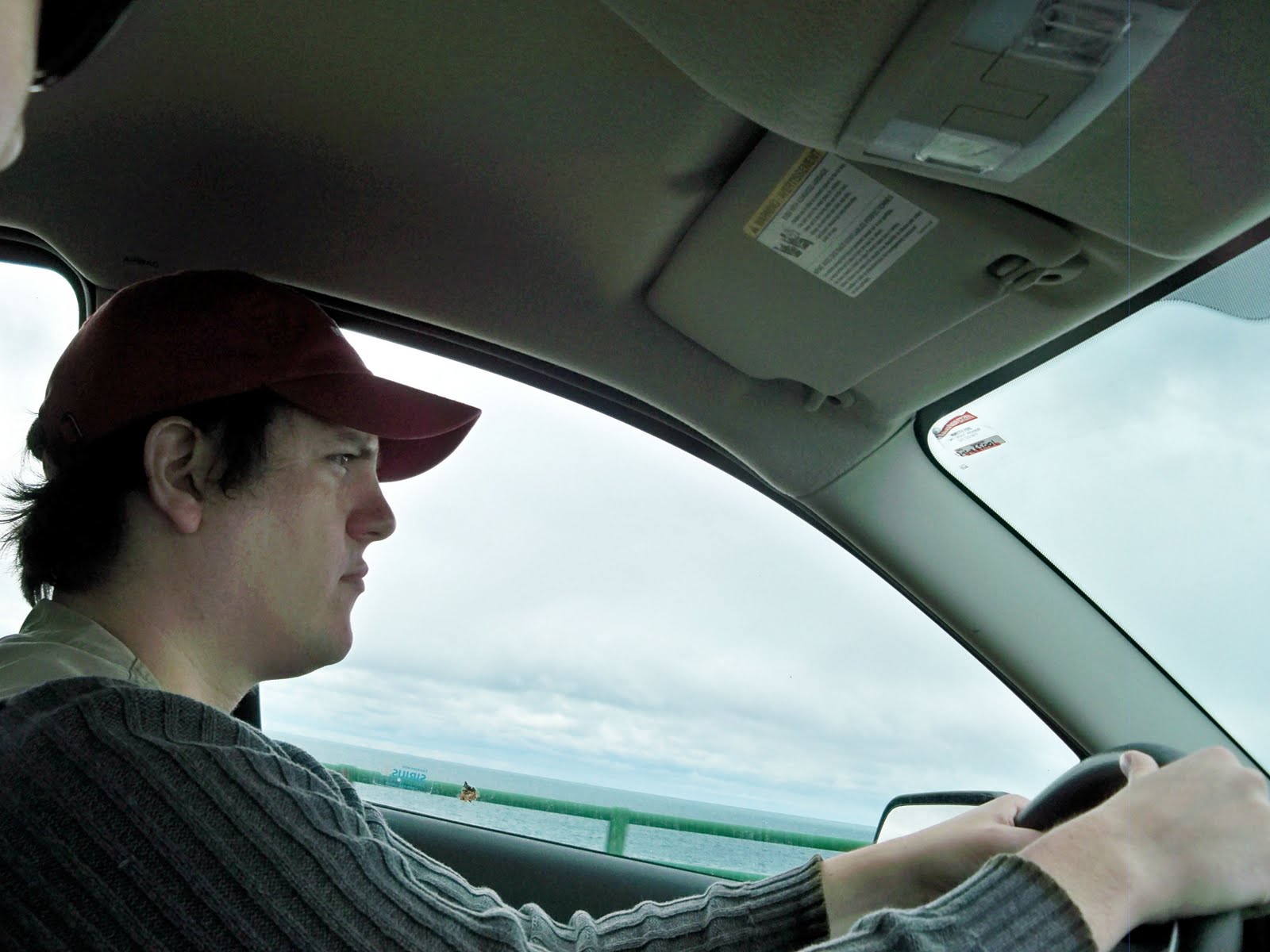
I failed to mention this to my wife this past weekend when we made a trip to the Upper Peninsula. Just as we reached the electric road signs that tell you to tune into the radio station for bridge information, she noticed a slight change in my driving demeanor.
“You OK?” she asked.
I didn’t tell her about my increased heartbeat rate. My dizziness. My cold and clammy hands.
“I’m fine,” I said. “Great.”
“Greetings from the Mackinac Bridge Authority,” a robot voice on the radio said. “We are experiencing very heavy winds today. Due to extremely frightening winds, we are escorting special vehicles across the bridge. Special vehicles include trucks hauling trailers, semis and anything driven by John Counts. If these types of special vehicles are not escorted across, the will surely plunge to a cold, horrifying death off the side of the bridge.”
That’s not what the radio said, of course, but that’s how I heard it. Then the main towers came into view, a bewilderingly 552 feet above water. The road itself is 200 feet high at midspan.
I shivered in my seat.
That’s a long way to fall.
I saw it all clearly my head: my car slowly moving across the bridge when a huge gust of wind comes whipping up from the Straits, lifting up the car and dropping it into the drink.
“Are you sure you’re OK?” my wife asked. “You look like you’re going to snap the steering wheel off.”
“I don’t like driving over bridges.”
There it is was. My confession. Now, my wife would know me for the weakling I am. But it’s been this way since I was a kid. The sight of the Mighty Mac has always made me dizzy in the same way that staring up the side of a skyscraper does in a big city.

It reminds me of how small we are, I suppose. That we are so inconsequential in the grand scheme of things. Which is probably why we build giant buildings and bridges to begin with -- to assert our domination.
Well, in regards to the Mighty Mac, I am the one that’s dominated -- with fear. I like to think it makes me humble.
I was ramrod straight, hand at two and ten o’clock on the steering wheel -- the way they teach you in driver’s training -- as I ascended the bridge.
My wife snapped a picture.
“Turn it off!” I screamed.
She giggled at me and put the camera away.
I stayed locked into the same driving position the entire five miles across the bridge. They call them suspension bridges, but I think of it as a bridge of suspense. Now, when you’re driving across the bridge, you can either go grate or rail. Both are not preferable. Driving in the outer lane, and you’re that much closer to the edge. Drive on the grate, and one of them is liable to come loose and drop you right through the road. Down and down 200 feet.
I always choose the grate because that seems slightly less likely to happen.
As I reached the toll on the U.P. side, I exhaled a giant sigh of relief. I smiled. I had made it over one more time without plunging to my death.
“Maybe we can take the ferry on the way back,” I said. “That might be fun.”
“They don’t have a ferry anymore. How about I just drive?” my wife said.
I didn’t argue with her.

Wednesday, September 28, 2011

Working stiffs: The Great American Job is dead and gone

Someone who is unemployed is watching television in their parents’ basement right now.
There are thousands of them. And they’re not young anymore. They’re in their 20s, 30s, 40s and 50s.
They don’t have a job even though they’re dying to work.
In Bay City when I was a kid, it was common for the older guys in high school to blow off studying because they would just go work at “The Chevy” when they turned 18.
Now, kids in that town -- and towns across the country -- are probably lucky to get a fast-food job upon graduating high school, college, even graduate school. And, since there’s a recession on, they’re probably told they’re lucky to have it.
These McJobs will keep an entire generation in their parents’ basements if something doesn’t change.
The idea that you’ll be able to prosper in this country as long as you work hard just isn’t true anymore. The Great American Job is dead and gone.
The Great American Job once meant enough income to comfortably pay for a house (that you own), a car or two, food and sundries and maybe enough left over to save a little for retirement or college for the kids. If you were lucky, you’d even have enough for a vacation once a year.
Is that too much to ask?
In the manufacturing sector, jobs have been replaced by robots and shipped overseas. Try and apply for what manufacturing jobs that are left armed with a high school degree and you’ll discover the competition is fierce, and not with people just trying to get started in the workforce, but folks who have been there for decades.
In the professional world, bachelor degrees used to mean something a generation ago, but now they are the equivalent of a high school degree. A lot of people have them, but it doesn’t guarantee any opportunities. For highly competitive jobs, you need a half dozen internships and to graduate near the top of your class. That’s great for those do-gooders, but what happens to the vast people in the middle who are average? Should they be relegated to sitting in their parents’ basement watching television?
So what is the best way to create jobs for these people?
That’s all I keep hearing from Washington. And I honestly think no one has the answer, including myself. The government shouldn’t be the sole creator of jobs, but neither should private industry. We don’t want the Government to get its fingers too intertwined in the means of productions. We all saw what happens when ideas like that are implemented. A colorless, fearful world of repression.
But what these Tea Party, limited government yahoos don’t want to acknowledge is that Europeans already had an arguably government-less economy without any regulations back in the days of oligarchies, when the nobility ruled over a peasantry.
Do we want America to resemble this? A mass class of peasants who serve up Frostys or help swipe debit cards at the gas station?
A very small middle class that is successful only based on their loyalty to the nobility?
And then the few at the top controlling all the wealth of our nation?
Without regulations, this New American Nobility would pay you less and expect more work because that’s what makes the highest profit, and making the highest profit is the basic guiding principle of business.
Whatever they figure out in Washington, I hope it’s a mixture of both. And it better be quick. The pessimism has grown strong. We need to dig ourselves out now.
Or pretty soon we won’t have any basement to go home to.

Another Ice Age or Dark Age?

As a child, I used to go to the Outer Banks of North Carolina this time of year on family vacations.
We had planned on going again this year -- last week, in fact. I’m sure glad we didn’t.
Anyone with a television or an Internet connection knows about how Hurricane Irene swept up the East Coast and hit the OBX pretty hard.
Whenever wild weather happens, we can’t help but think the worst: global warming. Well, that’s what you call it if you’re a hippie. If you’re on the other side, it’s called climate change.
See, the far left thinks all business should cease until we can restore the planet to what it was like before the dodo bird became extinct.
The other side thinks global warming is B.S., that either the scientific data is wrong, or that the scientists are in a vast conspiracy to impose such an insidious belief on the masses. If the weather is changing, the argument goes, it could just be natural.
So, is it the beginning of a new Ice Age, as a certain faction of Republicans would have you believe, or is the far right trying to usher us back into the Dark Ages?
“I think we’re seeing almost weekly, or even daily, scientists that are coming forward and questioning the original idea that manmade global warming is what is causing the climate to change,” said Republican presidential candidate Rick Perry in an Associated Press story recently.
Maybe Perry is listening to the “scientists” who designed the Creation Museum in Kentucky that has dinosaurs running alongside Jesus and other characters from the Bible. The far right’s definitely not known for its artistic prowess, but they also seem pretty deficient on that whole science subject too.
But you are the people they are trying to sell on these ideas. Do you believe them?
If you don’t believe in the science of global warming, ask yourself why?
Take out all the specifics, the details, and it comes down to this question: Do you think human beings have an impact on Earth?
If you live in a house and don’t open the windows for years, what would it smell like in there?
If you never had any maintenance done on your car, how would it run in a few years?
Do you really think billions of people crawling all over the planet doesn’t have some sort of effect?
It’s not political. There’s no conspiracy. It’s common sense.
I’ll leave the rest to the scientists the far right scoffs at, the same discipline that brought you such crowd-pleasing favorites as penicillin, airplanes and television.
In this regard, the far right is trying to drag us back into the Dark Ages where people were burned at the stakes for having any sort of opinion that ran counter to the Church. Now, instead of the Church, there’s Big Oil and every other interest that is tied to burning fossil fuels.
Is it too progressive or liberal to believe in science?
I hope I can still be considered a moderate if I think that Newton’s theories on gravity are OK. I hope I’m not considered a hippie if I believe the Earth is, in fact, round.
When it comes down to it, if you’re having a heart attack or stroke, do you want the science of rational folks who believe in evolution and global warming, or do you want a faith-based doctor -- I think they call them preachers -- at your side?

“All changed, changed utterly”: A view from Chicago on 9/11

Ten years ago I was 23 and living like most do at that age: desperate, impoverished, wildly irresponsible.
I had graduated from Wayne State University months earlier, in July, with a hopeless English degree. I could theorize with the best of them about the novels of French writer Albert Camus or quote from poems by William Butler Yeats, but I couldn’t land a decent job.
Throughout college, I had alternately lived with my parents in the burbs or on-campus in Detroit. After graduation, I followed my brother and then-girlfriend to Chicago. The girlfriend was still in school and lived in a sprawling, three-bedroom Northside apartment. I moved in, the only dude among three ladies.
I was ready to light the world on fire.
But so were the terrorists.
I truly hustled to find any kind of work I could. I scoured the Want Ads in the Chicago Reader, the town’s alternative weekly. I made dozens of calls.
Only one called back: The Chicago Opera Theater.
I had worked as a telemarketer during my teenage years, experience that landed me an interview. I hated the thought of selling, but it wasn’t like I’d be hawking something sleazy like male enhancement pills over the phone, I’d be helping to support the arts.
I got the job. My first day would be September 12.
On September 10, knowing that I was starting a new job and I wouldn’t have the luxury of spending my days watching television through a haze of cigarette smoke all day, I celebrated my newfound employment deep into the night.
Probably a little too late.
I was still asleep when the first plane hit.
It was a collision that changed my generation. And there I was. Asleep. Hungover.
I didn’t have a cell phone yet, so the call came in on the landline. I’m surprised it wasn’t being tied up by the gossiping gals.
It was my brother.
“Turn on the TV now.”
“Dude, I’m sleeping,” I managed to utter.
“I’m serious.”
Out in the apartment’s “family room,” which had the habit of attracting stray party people at anytime of the week, the TV was already on. Four or five people sat around on old, second or third-hand sofas and love seats watching the news.
I don’t remember who was there anymore. But I do remember seeing the second plane hit.
For a generation of kids who thought that “everything had been done before,” this was something that dropped all of our aimless jaws.
“What the ... !” we collectively said.
Chicago has big buildings, especially the Sears Tower. We dared not leave the apartment for the rest of the day. Patriotism, something not typical in the grungy Northside apartment, became fervent.
As Yeats said, “All changed, changed utterly.”
We were glued to the television, watching the world utterly change. All those needless deaths were sickening. The reverberations are still being felt. I would argue that the economy still hasn’t fully recovered. Nothing has ever been the same since that day.
All changed, changed utterly.
The next day, when I had to start the new gig as a telemarketer, I figured they would send us home, but they didn’t. For a few hours, I made calls asking people if they wanted to buy tickets to see Mozart’s “Cosi fan tutte.”
Most people hung up.
One guy said, “Do you know what just happened yesterday?”
I apologetically said I did and told him I was just doing my job.
He, too, hung up. The supervisor finally let us go home.
And we all did. But they weren’t the same homes anymore, all across the country.
All was changed, changed utterly.

Monday, September 5, 2011

Our boon companion: One year with Rudy the Wonder Dog


A year ago this week, we brought Rudy home from the Homeward Bound Animal Shelter.
There hasn’t been a dull moment since. It’s been a fantastic year with Rudy, or Roo, or Rudence, or Rude Dog, or any of the nicknames that come out of the mouths of my wife, Meredith, and I.
A lot has changed in that year, though. Believe me.
As a pup, I could hold him with one arm. Now, he’s as long as the couch when he stretches out.
Back then, he could barely climb the stairs. Now, he can hop up on a four-foot ledge in a single bound.
Lake Michigan terrified him last summer. Now, he’ll race out into the water and grab whatever you throw for him. You’d think he was part lab.
And according to his papers, he is, though you wouldn’t know it to look at him.
To us, he’s just a mighty mutt. Rudy the Wonder Dog. In the fall, he’s that elusive breed: the Manistee County Grouse Hound. All we know about him is that his mom was a lab mix and that pappa was a rolling stone.
But that hasn’t stopped people from guessing.
Walking Rudy around town is like escorting a celebrity. In fact, one day a gentlemen told me that Rudy “looked like a movie star.”
I thanked him and yanked Rudy away, hoping it didn’t go to his head. Rudy, as always, pranced off. He’s the fanciest prancer of a dog I’ve ever seen, which is why strangers stop us. He’s also chock-full of playful energy and has seemingly elastic ears that point and droop depending on his mood.
But the one thing people who stop us on the streets want to know is his breed.
I’m sorry, folks, but I don’t know if he’s part whippet, Jack Russell, dalmatian, pit bull or husky. That’s right, someone actually asked if little 60-pound Rudy was a husky.
“Well, you can always get a DNA test done,” one woman told me.
I politely nodded and thanked her, but the truth is my wife and I don’t care what breed he is. He’s our little mutt Rudy and that’s all that matters.
We love him no matter what.
Even when he passes noxious gas. Even when he tries to bring his rawhide bones into bed. Even when he eats junk.
And, for the first year, that’s been Rudy’s raison d’etre -- his reason to be: finding the strangest, grossest stuff, putting it into his mouth, savoring it for a bit, then swallowing it.
Our neighbor has a compost pile he likes to climb up and play King of the Mountain -- but in this game, His Highness Roo tries eating his way through the banana peels and yard waste.
Yum.
And then there’s fish. While many beachgoers lamented the alewife die off earlier this summer, Rudy welcomed the hundreds of dead little fish on the beach with opened chops. He doesn’t just like to lap them up, he also enjoys rolling around and rubbing himself on them.
Tasty.
Last weekend, we went to the Nordhouse Dunes where Rudy found a porcupine carcass and rolled around in that. I spent twenty minutes picking quills out of his coat.
Way to go Rudy.
Of course, there have also been chewed up shoes, “evacuation” accidents (”evacuation” being, of course, the silliest euphemism I’ve ever heard for when Rudy’s gotta take a leak or drop a deuce) and the not infrequent times he doesn’t mind his masters. He also likes to hog the bed and go outside at inconvenient times -- like 4 in the morning.
But Meredith and I wouldn’t give him up for the world.
Dogs make a life more complete, and Rudy has definitely done that. He’s our inseparable boon companion.
One year was great, but we’re looking forward to many more.

Thursday, August 18, 2011

Stuck in the middle

Let’s slash taxes. Let’s not even have a government except for a military.
Well, we could privatize that, too. So let’s abolish all taxes and let the market take care of it. Private militias will keep us safe, right?
The market will take care of everything. It’s the natural way. It’s the way of God. Excuse me, a Christian God.
Let’s make health insurance, pensions, police forces, fire departments and parks all totally private.
Every man, woman and animal for themselves. Survival of the fittest. Wait. Strike that secularist sentiment. Survival of the most devout.
Or let’s raise taxes on the rich. They make the most money, so they should foot the bill for our health insurance and retirements -- even though these are the people most of us work for and they’re already footing part of the bill.
Let’s redistribute all the wealth in the name of fairness, so even if you quit school at 16 and sit around smoking joints all day and playing video games, you have a quality of life relatively similar to someone who busts their rumps day in and day out.
Let’s create more programs so the irresponsible can continue to skirt responsibility. Let’s banish all religion from sea to shining sea -- and any of the morality that comes with them. This country ought to be an orgy of abortions, drunken debauchery and the spending of other people’s money.
We’re all worm food when we die anyway, so what’s it matter?
Well, what you believe does matter. It’s what puts certain people in charge.
Given the recent debt ceiling debacle it’s obvious that the extreme factions of political parties are becoming an issue. Has the gulf between Democrats and Republicans grown so large that all they can do is sneer at each other like kids on different kickball teams at recess?
My clarion call to all of you: stop being a bunch of crybabies. This country’s greatness was built on compromise and moderation.
Democrats have to learn to be more fiscally responsible. They’re beholden to every poor sap or welfare mom looking for a hand out. There’s always another deserving program that needs funding. They’re always ready to punish financially success folks with more taxes to fund a federal ballet camp, or something like that.
Stop it.
The Republicans are no better. They try to cloud their agenda with gallant magic tricks and illusions. They have duped people who make less than $200,000 a year into thinking that they represent you. They do not. Let me repeat. They do not represent your interests in Washington. The rich have been buying working class hearts and minds for decades by flashing an American flag and playing country music in the background of their political ads. Unless you belong to the country club, they are prying into your soul and stealing your votes.
This is what they do: they get honest, hardworking Americans riled up on a social agenda concerning abortion, gay rights, sex before marriage, religion in schools, and all that other baloney, but when it comes down to it, they really don’t care about that stuff. What they do care about is what all politicians care about: money and power.
So, with clowns to the left to me and jokers to the right, I am just stuck in the middle -- probably with the rest of the country. The folks who don’t go to Tea Party or PETA rallies. The folks who quietly head off to work each day and pay their taxes and try to pursue happiness within reason.
The folks no one seems to care about anymore.

The first role of a lifetime


If you’ve seen me in the last couple weeks walking around town mumbling to myself, I swear I’m not going crazy.
Unless you count joining a play with absolutely no acting experience an act of insanity.
That’s right, I’m not talking to myself, I’m trying to learn lines for my latest -- and probably ill-advised -- endeavor: acting in a play.
I have a small (yet crucial, of course) role as cowboy Virgil Blessing in the Manistee Civic Player’s production of “Bus Stop.”
It’s not as far-fetched as you think. I’m no stranger to the stage. I’ve played guitar in rock and roll bands since I was 14 years old and have played most of the large venues in the Detroit area like St. Andrews Hall, Clutch Cargos and, just this past weekend, the Majestic Theater.
Plus, I’m a Greek. Well, half Greek at least. My people invented drama. I like to think that my blood traces back to the great dramatists Sophocles or Aristophanes, though my ancestors were probably the folks who followed sheep around Mount Olympus with a shovel.
I’ve never harnessed any of those atavistic dramatic abilities until now, yet I’ve always wondered what it would be like to be in a play.
So far, it’s been a fabulous experience.
The director Jackie Karnisz and the rest of the cast have welcomed me with open arms -- and, thankfully, a lot of patience.
I joined up a few weeks after they already had the ball rolling, when my colleague here at the newspaper, Dave Yarnell, who plays Carl the bus driver in the play, asked if I’d be interested in playing Virgil.
I took a look at the script. Virgil is a cowboy. What American boy doesn’t love cowboys? He is also a cowboy that plays the guitar in the play. I could do that too.
Then, I read the entire play, scribed by William Inge, and really liked it. It’s funny. It’s sad. It’s a story about our American loss of innocence, and the archetypes that played the roles in that grand drama of changing ideals as our country went through its painful adolescence (Civil War, the settling of the West) and young adulthood (Word War I and World War II). It’s also a story about the sexual politics of a society becoming increasingly liberal. Set in 1955, the play’s main character is Bo, a young, eager, post-pioneer cowboy in an era when the West was all but closed. He monomanically purses the slatternly Cherie, a nightclub singer and fallen woman. They are each other’s redemption. The drama unfolds while a busload of disparate American characters confront their own dilemmas while waiting out a winter storm at a diner in Kansas.
Antics, of course, ensue.
Getting involved in the play was a no-brainer after reading it. Virge is basically Bo’s right-hand man. A guitar strumming oracle. A touchstone of comfort for the young cowboy.
It was all fun and games until I started highlighting the lines I had to memorize. There were a lot of them. While stage-fright isn’t something that freaks me out too bad, there’s nothing more terrifying than forgetting what you have to say in front of a bunch of people waiting on you to say something.
It’s the stuff of nightmares, right?
In addition to that, you
But, like I said, the director and cast have been wonderful and forgiving whenever I mess up, especially Clyve Lagerquist, who does a terrific job of playing Bo, and Theresa Pepera, who does an equally great job of playing Cherie. I have most of my lines with them, and they -- as well as the rest of the cast -- have been nothing but encouraging.
So, with that said, the play opens up this Friday at the Ramsdell Theatre at 7:30 p.m. and will continue with 7:30 p.m. performances on Aug. 13, 19 and 20 and 2 p.m. performances on Sundays, Aug. 14 and 21.
Come and check it out.
Hopefully I’ll remember my lines.

Remembering an old friend: Driving to high school in a 1970s Mustang with no heat

Death’s bewildering nature stops us in our tracks.
When someone we know dies, we feel as if we should do something, but there’s usually nothing to do but mourn.
And mourning is a strange enterprise, specifically because those of us who survive suffer from an ineffable helplessness.
Dead is dead.
Gone is gone.
There is nothing we can do.
Deaths are even more poignant when the person didn’t make it out of their 20s or 30s.
I was scanning the headlines today and was saddened to discovered the death of an old friend.
Jevon Hollywood (born Hotchkiss) died Monday after being struck by a car on 7-Mile Road in the Detroit area, near where we both attended high school together in the suburb of Livonia. He was 34-years-old, a year older than me.
Jevon changed his last name to “Hollywood” when he became a radio DJ. I wasn’t surprised he became a popular disc jokey in Detroit. His last gig was at WDTW-FM, 106.7, The Beat.
My entire junior year, Jevon and I commuted together to a different Livonia high school for a three-hour radio and television class. This was back when I thought I was going to be the next Francis Ford Coppola and the class was the closest thing my school had in the way of film-making.
Jevon and I were the only students from Franklin High School accepted into the program at Churchill High School. He was a grade above me, but we knew each other socially, so he didn’t mind if I caught a ride with him in the morning and got a ride back to our own high school at lunch.
Even back then, Jevon had flair. We drove to the other high school in a 1970s red Ford Mustang he had somehow acquired. The car had no heat, and didn’t start reliably, but we usually made it without the help of parents.
I grew disinterested in radio and TV and dropped the course the next year. But Jevon kept going.
A few years later, I wasn’t surprised to hear him on the radio. He was also well known around town for hosting parties and other radio-related events.
I last saw him at one of these maybe five or six years ago. He was standing up on a podium with a microphone, pumping up the crowd at the bar a friend and I were at.
We shared a drink when he had a break. I asked him if he still had that old Mustang.
He smiled -- he had an infectious smile -- and said he’d gotten rid of that piece of crap years earlier and had moved on to a nicer car.
We shared a couple of memories about riding to school in the winter and having to be real bundled up because it didn’t have any heat.
We chatted for a few more minutes then drifted out of each other’s lives again.
Until now.
I wasn’t surprised to read in the Free Press’s account of his death that Jevon was probably drunk at 5 a.m. and walked in front of a moving car while it was raining.
Like many of those who bring bright, electric joy into our lives, Jevon lived fast.
But it doesn’t mean he had to die so young.

Can America think big anymore? The crash landing of our cosmic confidence

I didn’t want to be an astronaut when I grew up.
I figured by this time, I’d be a ship captain like Hans Solo and the term ‘astronaut’ would be historical.
There would be galaxies to explore. Aliens to pal around with. Cool, new ships to pilot.
I’d be an explorer for a new era.
That’s why it’s so discouraging to see that NASA is retiring the shuttle Atlantis and will end manned missions into space. The four American astronauts are now on their way back to Earth from the International Space Station, and when they return, a dream will have landed.
Obama and Congress can talk all they want about hazy plans to send missions into deep outer space, but that’s dependent on if we can figure out how to live together on this planet first.
Or, at the very least, in this country.
The saddest thing is that no one seems to care all that much. The only thing Americans are thinking big about are themselves.
Just look at the technological innovations we value. Are they rockets and manned missions into space?
No.
Want to know why? Because they haven’t found anything worth exploiting out in space yet, no planet with giant reserves of oil or nacho cheese. No one wants to fund an expensive program with lofty ambitions. When more practical concerns demand our attention, I fully agree funding something like the space program should be cut. It’s just sad that all these problems -- power grabs, climate change, financial meltdowns, earthquakes, warfare, welfare, abortions and Michelle Bachman’s presidential bid -- so consume our energies that we don’t dream big anymore.
Instead, our technology -- and our mentality -- goes sideways. We can play Tetris on our cell phones while driving, watch episodes of “Malcolm in the Middle” on an iPad in an airport and have face-to-face video Skype sessions with Mongolians.
Never before has information -- words and images -- been so easily disseminated across the world.
Meanwhile, the American empire crumbles.
Technology is all socially driven these days. It’s not shooting up in the air anymore, it’s ringing in our hands or flashing in front of our faces.
While social networking tools like Facebook have been credited with helping with the so-called Arab Spring revolutions in the Mideast recently, just how important are these technologies to mankind?
The only thing we’re using them for is to socialize. A new way for a single dude to pick up chicks. A new way to share a recipe with mom. Amusements and frivolities.
These proliferate with reckless abandon while the space program, once the innovator in technology, continues to lose relevance in our nation’s collective imagination. It therefore loses funding.
There’s an easy explanation for this: humans are narcissistic and vain. For the most part, we only care about ourselves, then our families, then our friends. We’re usually not walking around with Big Ideas about the fate of humankind and the great mysteries of existence that could be answered out in the deep blackness of space.
Most of us are walking around thinking about where to eat lunch or what gossip to Tweet from our smart phones.
Remember, all these superfluous gadgets are at the mercy of the satellites orbiting the earth.
And those satellites got there by thinking big.

Patriotism is not a competition: Celebrate independent thought this Independence Day

Like any other holiday, the Fourth of July has morphed into something different than what it started out as.
We think of fireworks, barbecues and getting together with friends and families.
It’s sometimes hard to remember that we are celebrating the birth of our great nation.
And even with all our problems, as I purvey the world scene, I’m still damn proud to be an American.
The most patriotic person I know is my grandma. In her 80s, she watches the news more than anyone I know. She holds deeply felt political beliefs. She will be the first to tell you that she loves America.
That same grandma also didn’t speak English until she was five years old.
That same grandma’s parents were born in Greece and came to this country in the 1910s for a better life.
They found it.
This is the type of patriotism I’m glad to be a part of.
Patriotism is a strange thing these days, though.
There is a certain element in our political culture that would have you believe they are more patriotic than you because they espouse certain “family values.”
There are some folks who seem to believe that to be an American you have to be white, Christian and heterosexual. These same kinds of people make up the ranks of “birthers,” the folks who can’t possibly believe our African-American president with a weird-sounding name could actually come from “their” country.
The patriotism that makes me grimace has most recently come from our friends in the Tea Party who will have you believe no one is more patriotic than they are. They dress up in silly, historical costumes and pull out the fife and drums at events.
Pack up the pageantry. Patriotism is not a contest. Bowing down before the flag and the Constitution with jingoistic fervor without questioning anything isn’t the way the Founding Fathers would want it to be.
What we fail to forget sometimes is that the dudes who started the Revolutionary War were, well, revolutionaries. They went counter to the status quo of a monarchy.
So, whose side do you think the patriots would be on?
The folks parading around in their costumes, or those trying to actually solve realistic problems instead of worshiping the past without any doubts whatsoever.
It would be refreshing if we had a little independent thinking this Independence Day.
And this goes both ways, both extreme sides of the political spectrum. Blowhards on the left are just as dogmatic about their beliefs (if they have any.)
They’re fixed on the evils of laissez faire capitalism and think every Republican sits up in a castle thinking about how to rid the land of minorities and homosexuals.
So, this Independence Day, think about everything that makes our country great, namely our freedom to have any such ideas and be able to freely express themselves.
Once you’ve become a U.S. citizen -- like my great-grandparents did so many years ago -- you are an American.
There is no way to be more American than anyone else.

TALE FROM THE TRAILS PART THREE: No sleep till Stronach: Walking the final miles summons reflection


In drama, the third act is when the action reaches a climax, leading to a resolution.
The prince finally slays the dragon and marries the princess.
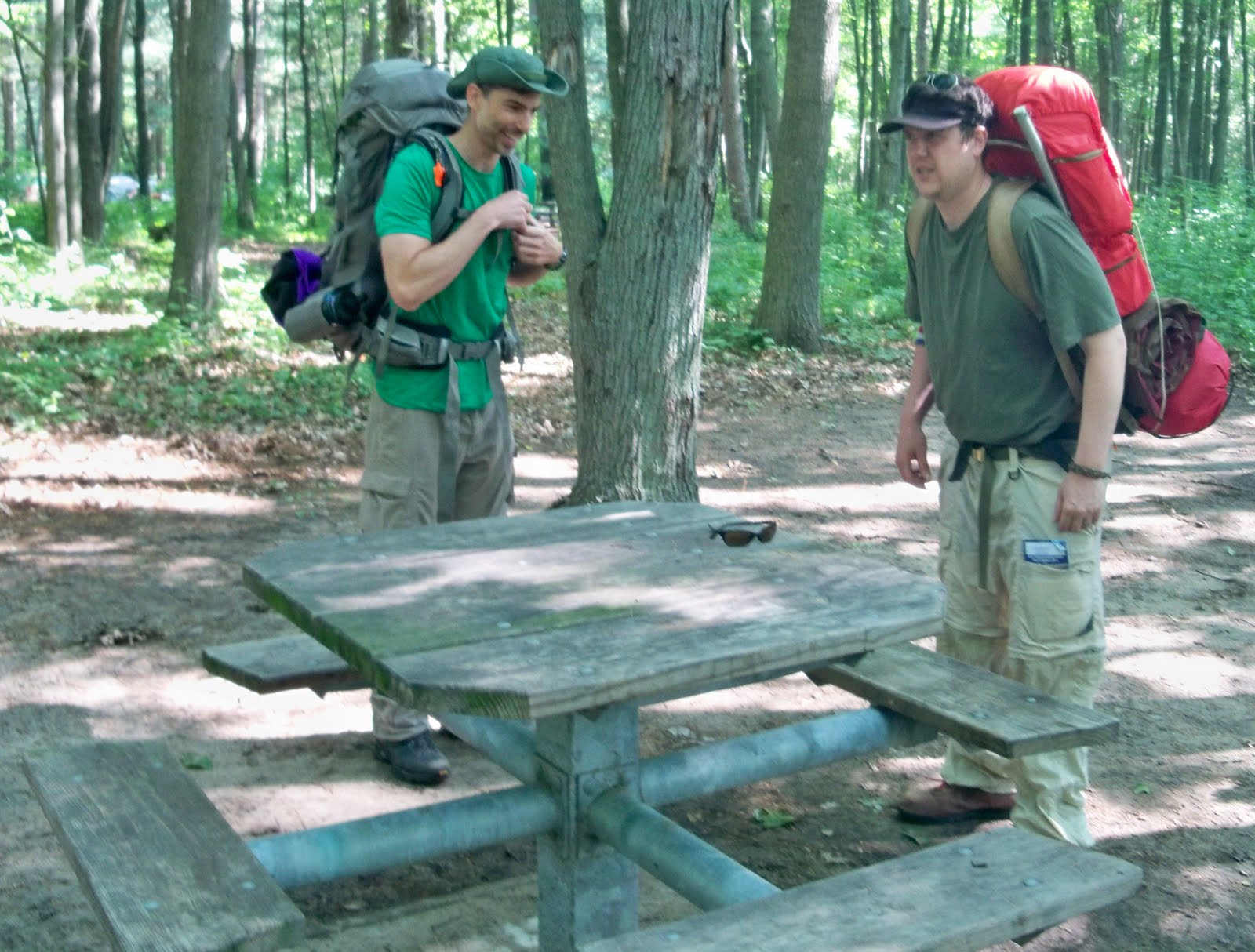
In this story, three trail-weary gentlemen abandon their heavy backpacks and walk the road toward Stronach, more than 30 miles from where they began the journey at the Marilla Trailhead on Day One.
Stronach was our final destination, our unwitting princess. The trail, of course, was our dragon.
Day Three was different than the rest.
The first two days of our grand hike had been brilliantly sunny. The final day was overcast.
Day One, we got on the trail around 9:30 a.m.; Day Two, after the epic 20-mile hike, we didn’t get started until 11 a.m. On Day Three, we hit the road around 7:30 a.m., eager to bring the adventure to a close.
But everything was reaching a climax, mostly the toll the trip was making on our bodies.
There were blisters and bruises. Sore muscles and joints. Mental and physical exhaustion.
It was anguish pulling on the boots that last day. It hurt to breath. We took to River Road and moved slowly toward town.
We were loving every moment of it.


SLEEPING UNDER THE STARS

The night before, we were still firmly at the tail-end of Act Two.
We were camped on the Little Manistee River off of Little River Road, just a touch west of Six Mile Bridge. Despite having my old man and his Jeep along for the ride after our shameful five-mile shuttle down Koon Road, we weren’t living like car camping kings.
I haven’t yet mentioned the rations. You’d think walking 10 to 15-plus miles a day would mean our bodies needed thick juicy steaks and energy-giving carbs like pasta.
Not so.
Not only isn’t it practical (or sanitary) to hike with raw meat in your backpack, I think it would be unnecessary. (Bears, I’m guessing, would think otherwise.) Now, if you take a glance at me, you can tell I’m in the Clean Plate Club: no French fry left behind.
But on the trail, the body -- and the mind -- transform. Your normal hunger is vanquished. I just didn’t have much of an appetite.
Which is good, because all we had to eat were noodles and soup heated on a small backpacking stove.
Food on a backpacking trip, after all, is nothing more than basic fuel.
When “dinner” was finished, we hung out by the bonfire under a black canopy of night sky spangled with stars. Before crawling into our tents for the last night in the woods, we pondered Act Three. Unlike characters who live in the predetermined world of a drama, we free-willed human beings have the creative power to author our own tales.
Lives are rife with endless possibilities.
In the morning, we’d only have about a six or seven-mile hike to Stronach. Then we would be done. Our main decision was to relieve our backs from the burdens of our packs. We’d leave them in the Jeep. I was amenable to this -- especially after the shuttle. We’d already cheated. What did going packless matter?
Then suddenly, I was starting to get brave again.
“Kids used to walk to school farther than that,” I said.
Since we’d had a fairly normal day of hiking -- only 13 or so miles -- I was feeling cocky, though I may also have been emboldened by the flask of whisky I was sipping from.
Falling asleep that night, I had visions of myself jogging those miles not only to Stronach, but all the way to Lake Michigan where the entire town would greet me, hoist me on their shoulders and parade me around.
Ah, you gotta love a little snort of the good stuff before bedtime.
I never slept so good in my life.


STRONACH CALLING

Everyone woke early.
Six a.m.
There was no grumbling, just precision-like packing up. Two days in the woods had turned us into a well-functioning unit.
Our bodies still quaked with pain, but we had a few measly miles left, and we weren’t going to lollygag.
It was Stronach or bust.
Chris couldn’t even pull his boots on one more time. He’d bought a new pair for the trip and they weren’t properly breaking in.
“I’m going to throw them at the salesperson’s head when I get home,” he said.
Instead, he wore a pair of sneakers. We loaded up the Jeep and hit the road.
Walking without a pack was strange at first. The pack gives you purpose.
Instead, we just looked like three dudes walking down a rural road. I’m surprised we didn’t get stopped by the cops for being suspicious characters.
Little River Road follows the Little Manistee River on the north side into Stronach. It’s mostly federal forest on either side until you get closer to town, when homes and cottages appear inside the trees.
It was a casual walk. There was no great mileage we needed to achieve.
Our journey was coming to a close.
It began to settle in when we reached Stronach Road. I had forgotten to mention to the fellas that it’s a trucking route.
A semi whooshed by us, nearly knocking us on our backs. There were more houses and barking dogs.
We were back to the world humans had built.
The Jeep scooped us up near Water Street and we were whisked into town without any fanfare. We were too tired for anything other than a shower and cheeseburger. Our feet and legs were numb. Our spirits weary.
But I definitely felt a subtle spark.
We had made it.
We had finally made it.

AFTERMATH

The journey is never over.
It’s part of memory, part of my story.
And that’s one of the reasons I had proposed the hike to begin with: to alter my personal narrative a little bit.
Our post-industrial lives are filled with dread and monotony. We work, we watch TV, we scoop processed food into our mouths and we sleep.
I like to think that there’s more, that if we break out of the quotidian, we can better understand what this living business is all about.
The frontier may be settled, and there may be no lands left to explore, but the mapped world gives us the opportunity for inward exploration as we check out the non-manmade world.
We humans are shrewd manipulators of nature, so shrewd that we assume we are not a part of it anymore. That’s why it’s so easy to listen to arguments that will lead to the destruction of our habitats.
As a culture, we tend to think of nature as a thing which we don’t have a connection with anymore. It sadly becomes a “lifestyle” choice.
“Oh, I’m into the outdoors. I’m into nature.”
Well, we’re all part of nature, and nature is a part of us. No amount of movies, make-up and Chevy Malibus will change that.
What also made me want to go on the trek was to experience the land around me in a more intimate way.
I can safely say that Manistee County is one of the most beautiful and rugged areas in the state. The woods, rivers, meadows and glades are a treat.
I will carry them with me internally forever.
As for the fellas, we’ve been in constant correspondence since our adventure.
“Dude, I’m gonna come back up there and walk those last five miles to make it official,” Moldovan e-mailed me when he saw yesterday’s installment.
My brother was more ambitious.
“What other areas up there need to be hiked,” he wrote me the other day. “I’m ready.”
I told him it’s a big county.
I’ll be up for it as soon as my feet are.


Tuesday, July 12, 2011

TALES FROM THE TRAILS PART TWO: Aches and pains, but it was worth getting moving after grueling first day


Day 2:
The sun was up.
I heard voices.
I grumbled and rolled back over and went to sleep in my tent.
Who cares about walking across Manistee County? I thought to myself. What a dumb idea.
I did not spring up Sunday morning raring to hit the trail. Far from it.
My body ached like never before. My legs were burning. My shoulders hurt.
When I fell asleep, I was telling myself that we probably wouldn’t be able to move the next morning, let alone get back on the trail with our heavy packs on.
We stayed the first night at Sawdust Hole where we had met my old man, a backpacking veteran. On this trip, he was our spotter in case things got, well, spotty.
They did.
When I finally pulled myself out of the sleeping bag and stumbled out of the tent, howling and hobbling, feeling like I was 93 instead of 33, I looked at the old man’s Jeep parked near our backpacks and had the fleeting thought of surrender.
Twenty miles was enough.
We could toss the packs in the Jeep, stop at the Taco Bell and get a Nacho Bell Grande and go sit in the air conditioning and watch “Air Bud.”
“So, what’s the plan?” I asked the boys, who had also just woken up and were making coffee around the picnic table.
“What do you mean?” Chris said. “We hike.”
I yawned and stretched. I didn’t think I could walk 13 feet let alone the 13 miles to the Six Mile Bridge area on the Little Manistee River.
Those were my shoddy calculations, though. Moldovan was going over the maps with his mad navigational skills. He determined it might be farther.
“Yeah. OK,” I said, not believing myself.
None of us were very gung-ho to get going quickly, though. We puttered around the camp for an hour or so. I drank some coffee and ate some Nutter Butters and felt better.
The plan was to hike as far as we could and call in the old man if we got too tired.
We begrudgingly strapped our packs on and hit the trail.
We walked.
And I’m glad of it, even if we did have to cheat to get through the day.


A FABULOUS MORNING

In our post-trip correspondence, the fellas and I have decided that the hike between Sawdust Hole and Highbridge Road was the best.
As soon as we left Sawdust, we were only in the woods a short time before the world opened up and we were in this wonderful meadow.
Birds flitted across the tips of the tall green grasses. Much of the trail was now a path of wooden planks.
We were in the land of the bayous.
There was a sign: “Sawdust Pile: In the early 1900s this bayou was the location of several sawmills. Lumber was hauled by narrow gauge railways and local merchants.”
Beautiful landscape and a sense of history. Who could ask for more?
The trail soon wound next to the river. It was wonderful walking.
My joints were loosening up. My muscles didn’t ache so much anymore. The sun was out.
Twenty miles yesterday didn’t mean a thing anymore. I was feeling up to 20 more.
The elation was short-lived. We were getting nearer to civilization now.
We stopped for a break at the spot where High Bridge used to cross over the valley. We pulled off our packs, sat down and ate trail mix while drinking from our water bottles. The roar of cars could be heard in the distance. We milked this break for at least fifteen minutes.
There were paved roads, cars and people to contend with soon.
We wanted to savor a fabulous morning while we could.


THE PAINS OF CIVILIZATION

We started to name our pains.
The red raw chafing on my, ahem, upper thighs -- which required an emergency trip to Kaleva Meats in the Jeep that morning for diaper rash ointment and Gold Bond Powder-- was dubbed Gary.
Chris’s shoulder pain was named Phil. He called his malodorous body stench Saginaw after the town near Bay City where we grew up.
I had two pains in my shoulders where my pack was strapped that I named George and Doris, after the fellow we saw failing to get his boat going at the High Bridge River Access, where we stopped for a break.
It started as another lovely respite from walking. I stripped down and cooled my raw legs in the cold Manistee River. I imagined smoke rising from the water as I dunked in my derriere.
“Ahhh,” I said.
We all waded in the river. Chris and Moldovan hadn’t slept very well because their air mattresses had leaks, so they blew them up and rolled them around in the water to find them.
Moldovan was walking up the very wide cement boat launch to patch the hole when “George” started backing in the motor boat hitched to his truck.
“George” had more than enough room to go around Moldovan, but instead basically forced him to move out of the way.
Moldovan restrained himself, walked up to the picnic table where our gear was strewn and calmly continued fixing his air mattress.
“George,” an average-looking middle-aged dude, plopped his boat in the water and parked the truck. His lady-friend was around the same age, with hopeful gold jewelry around her neck and wrists. She wore a sun hat for a day of boating.
While we went about messing with our gear and washing up in the river, “George” attempted to get the boat’s engine started -- and failed.
“Well, so much for getting out on the river,” he said to “Doris.”
He pulled the boat out of the river and they went on their way.
We had spent most of the last 24 hours in the secluded woods. Still, had “George” not tried to run Moldovan over, I’m guessing we would have hardly noticed them. Now, though, this seemingly minor incident and these strangers stirred our imaginations.
Wives and girlfriends sometimes ask what their menfolk talk about while together in the woods doing manly things. Here’s a (censored) tidbit of what our conversation may have sounded like as we reached the woods on the trail again:
“That guy was totally taking that chick out on a date. He borrowed that boat and couldn’t get the engine started.”
“She was totally a washed-up divorcee looking for some love.”
“He was planning on dropping anchor on a secluded bank and ravishing her.”
They suddenly turned into 1950s soap opera characters with deep, hysterical, exaggerated voices.
“Oh Geooorge! Take me!”
“Oh, Doooris. But what about my wife?”
“I don’t care about her, even if she is my best friend.”
“Oh, Doooris, you’re so bad!”
“Oh, Geooorgie! Naughty little Georgie. Kiss me now!”
So, when my shoulders started hurting later on that day, I named my pains after two people completely unknown to me who may have been brother and sister for all we knew.
But when you’re on the trail, creating such elaborate scenarios is your only entertainment.
Otherwise, you’re just thinking about what hurts.


OUR CHEATING HEARTS

Five miles.
That’s the distance we covered the quickest on our trek across Manistee County.
But that’s because it was in the old man’s Jeep.
Five miles.
That’s all that’s keeping me from making a legitimate claim that I walked all the way across the county. Otherwise, I’d be standing up atop the Briny Building right now, shouting it out.
But, as I said in the Day One dispatch, we failed.
Here’s why: Gary had a blow torch, Phil had grown fangs, George and Doris had given each other hot, burning STDs and Saginaw was scaring away any wildlife we might encounter.
“Dude, my feet are en feugo,” Chris said at the Udell Trailhead, and for several miles afterward.
This is probably the only Spanish word he knows, by the way.
The stretch between High Bridge and Udell on the North Country Trail (NCT) is not quite inspired. It’s mostly walking past houses on roads. Several dogs weren’t too happy to see us coming.
So, we took a break at the Udell Trailhead, pondering our next move. We’d have to tackle a lot of uphill for the next couple miles. It was already late afternoon. As we sat on a picnic table comparing who had the angriest looking blister, it was decided: we’d call in reinforcements. The plan had always been to take the NCT through Udell Hills to Koon Road. Then, the itinerary had us walking about five miles down Koon and Skocelas roads until we got to the Six Mile Bridge area.
“Call the old man to pick us up,” Chris said. “Those are garbage miles anyway. My feet are really en feugo.”
We were all in agreement.
The hills were all uphill and very buggy. It was hot. My body was starting to feel the 20 miles from the day before, not to mention the 10-plus miles we had already done on Day Two.
It was a relief to reach Koon Road, pull out my cell phone and call the old man, who was there in about five minutes. We piled the packs inside the car and traveled the five easiest miles we had in two days.
I admit it: I cheated.
I’m glad I did.
So is Gary.

Wednesday, July 6, 2011

TALES FROM THE TRAIL: ‘Embrace the unknown’ Miscalculation ends up in epic 20-mile hike


We failed.
Or we succeeded with an asterisk.
It all depends on how you look at it.
We walked down a seemingly endless trail until our feet throbbed and our spirits waned. We walked until we started to hallucinate and tree stumps turned into trolls. We walked to the point of near collapse and still couldn’t officially make it.
We were beaten by the land, the hills, the very earth of Manistee County.
The goal was this: hike across the county from Marilla Trailhead to Stronach.
In this, we failed (see tomorrow’s Day Two installment for the details).
But we succeeded in so many other ways that by the end of the ambulatory journey no one cared.
I’ve never tried so stupendously hard at something. My body and mind have never been so pushed to the limits and tested for endurance.
I’m still around to write about it, so I guess I’m OK, though I’ll admit I’m slightly changed by the experience. There is no other way to know the land as intimately as this. You are not a spectator anymore. You’re part of it, moving at its speed.
I feel I’m now more joined with the land around me.
I’m also very tired.
In the end, we logged an estimated 39 miles in three days, most of them while carrying 30 to 40-pound backpacks. From the countyline around M-39 to the big lake down M-55 is approximately 28 miles. This is where the asterisk comes in. Had we walked the side of the road straight across the county, we would have easily made it.
Instead, on Day One, we contended with the hilly bluffs and ridges along the Manistee River valley. On Day Two, it was the heat, the bugs and the Udell Hills. The foe on Day Three was ourselves.
Our exhaustion. Our blisters. Our pains.
But it was all part of the journey.

EMBRACING THE UNKNOWN

The three of us started out with such noble intentions and high aspirations.
These were completely obliterated after Day One.
Before I get to our grueling first hike, let’s go through the cast of characters for this particular adventure.
My brother, Chris, is a construction guy from Detroit. If you ever get to the casinos down there, take a look around at the drywall and acoustical ceilings and it might just be the handiwork of the company he works for as a project manager. He’s the more experienced backpacker, having logged several more trips to Isle Royale than I have. He’s also tackled part of the famed Appalachian Trail.
A few of the trips he’s taken to Isle Royal National Park -- an island completely devoid of cars in Lake Superior -- have been with John Moldovan, his friend from the old neighborhood, Livonia.
I’ll use his last name to avoid any confusion with my own. Throughout our trek, my brother constantly had to say our full names.
“John Moldovan, do you have the water pump? Take down the tent, John Counts.”
That sort of thing. This will make it easier.
Moldovan is currently a PhD candidate in molecular biology at the University of Michigan in Ann Arbor, where he works in a lab doing stem cell research. Before that, he served for nine years in the Air Force, where he was stationed in Kyrgyzstan, Alaska and Little Rock, Ark.
While he was in the Air Force, Moldovan was a navigator, which means the mapping duties should have been immediately delegated to him.
Since the cross-county trek was my harebrained idea and I was in close proximity to set GPS coordinates, it was left to me, though.
Bad idea.
But I’ll get to that.
The mood was downright jovial when we got to the Marilla Trailhead Saturday morning. The beginning of a journey is always filled with expectations: “What kind of strange, wonderful, scary things will happen to me,” you think.
Our mantra, as we headed toward the Big Manistee River through the woods, was: “embrace the unknown.”
By the end of the day, I was cursing the unknown.
What we thought was going to be about a 14-mile day to Sawdust Hole turned out to be a lot longer.
It would turn out to be the longest hike any of us had ever taken. Eleven hours. Twenty miles.
There was only one way to describe it when we finally did get to Sawdust Hole: epic.


AS THE CROW FLIES

The bluffs drop dramatically down to the mighty river. An eagle soars out of trees and over the water across the valley (we saw three of them). The trees reach heavenward toward a fabulously blue sky.
The Manistee River Trail is truly rugged and beautiful.
Much of the trail seems uphill both ways, but it’s worth it. We made our way across the suspension bridge and followed the river south, where there are fantastic views of the river and some very nice camping spots.
Around 3 p.m, after five hours of walking, we stopped at one of these sites for a rest. We’d run out of water already, so we pumped some from the river with a water filter. Chris pulled out a four-piece fly rod and made a few casts. Moldovan and I took a nap.
We should have stayed there overnight. Instead, after a half hour, we packed back up and ended up walking another five and a half hours.
My main mistake was relying too heavily on the GPS unit, which said it was around 14 miles to Sawdust Hole from Marilla, where we would have to get the first night if we wanted to walk the whole county.
But it was 14 miles ‘as the crow flies,’ not as the actual trail went. My first mistake was assuming that because our destination was listed as 13.5 miles from Marilla on the North Country Trail that it would be roughly similar if we hopped over to the Manistee River Trail.
Around 5 or 6 p.m., it was obvious we weren’t making the kind of progress we had intended.
We were tired and weary, but still had a long way to go.
That’s around when Moldovan told us the story of Lance Sijan.


REMEMBERING LANCE SIJAN

As part of his Air Force training, Moldovan was required to read a book called “Into the Mouth of the Cat: The Story of Lance Sijan, Hero of Vietnam.”
Sijan was a 25-year-old Air Force pilot when his plane went down over Laos in 1967 on his 52nd combat mission. According to the book, he suffered multiple injuries, including a fractured skull and a compound fracture of his left leg. He didn’t have any food or water with him.
He survived for 46 days in the jungle.
He was captured and then escaped after overpowering the enemy.
He died getting pneumonia in his weakened state after being recaptured.
“We have, like, a few more miles to go,” one of us said. “Sijan was in the jungle for 46 days with broken limbs, crawling around on rocks.”
It became our rally cry. Whenever someone started to complain or baby cry, someone would say, “You think Sijan would be bellyaching like that?”
And there was a lot of time to complain.
We hoofed for hours, dogged tired, through the forest. At times our conversation was very animated (and, for the most part, many of the words unprintable in a family newspaper), but by the end of Day One, it was a silent trudge through the forest. We left the river behind us and reconnected with the North Country Trail. Here the woods were a lush, fertile green. The trail seemed interminable.
When you’re quietly hiking in file down a trail, you aren’t looking around you so much as you’re looking at the boots of the guy in front of you. If you’re setting the pace, you mostly look down at the trail.
Then, around mile 18 with nothing but some granola and filtered river water in your gut, the trees start talking to you. The enchanted elves and fairies of the woods come out to greet you and lead you to an imagined land of Barcaloungers, cocktails and steaks. You don’t have thoughts as much as you have short, quick jolts of mental activity that don’t connect.
“Just take another step,” you think. “Take another step. Another step. Step. Step. Step. Step.”
Then, someone says, “This sucks.”
“I’ve got blisters on my blisters already.”
“My hips are killing me.”
“Dude, think about Sijan. He had broken limbs, crawling around in the jungle. Don’t be such a wuss.”
We pushed on and finally got to Sawdust Hole where my old man, who was spotting us with his Jeep on our journey, had been waiting for hours.
We quickly set up camp and ate. No one was up for too much conversation. I slipped into my sleeping bag half-delirious.
There were serious doubts about whether or not we’d be back on the trail the next day.